Culion Islands, Philippines
For three days the sun sits on us. In this wide place of sparkling waves, wet nylon flags flutter above me, sleeves tied around pillars, and I feel like the heat is pressing me powerless into the crevices of painted wood rocking underneath, the shadow of the narrow roof moving relief briefly over my body and away again. When we’re on the beach, the light comes from everywhere, and cupping my hands over my eyes is not enough, because the ground is white sand and brilliant coral and it presses up up up while the sun presses down and all I can do is squint to see the blue that I’ll marvel at in pictures later.
But in the water, everything is different. It was hard to breathe through the tube at first – one heavy inhale to inflate the soft belly of its curve, another to inflate my lungs. I turn my head too far, sputtering in saltwater, and thrash upwards, freeing myself of rubber bits. Matteo tells me instead to keep my head under and spout like a whale. Then, I practice a tense grip with my teeth on the denture-like seal, and the breath becomes fluid in a sky of water. It doesn’t look blue, but it feels blue.
I slowly trust myself to float face-down. When I do, I see the blue too, but it’s not the water itself. It’s indigo banks of coral that mimic the sky, with white expanses of sand in between. Interspersed in this tranquil landscape are craggy towers of yellow-brown, studded with what look like tiny neon plastic Christmas trees, cones of feathered layers stacked on a central stalk. Matteo lunges under in a shallow arc and wiggles his fingers at them. The colors vanish in an instant, fibrous tongues retracted into little mouths in the coral wall.
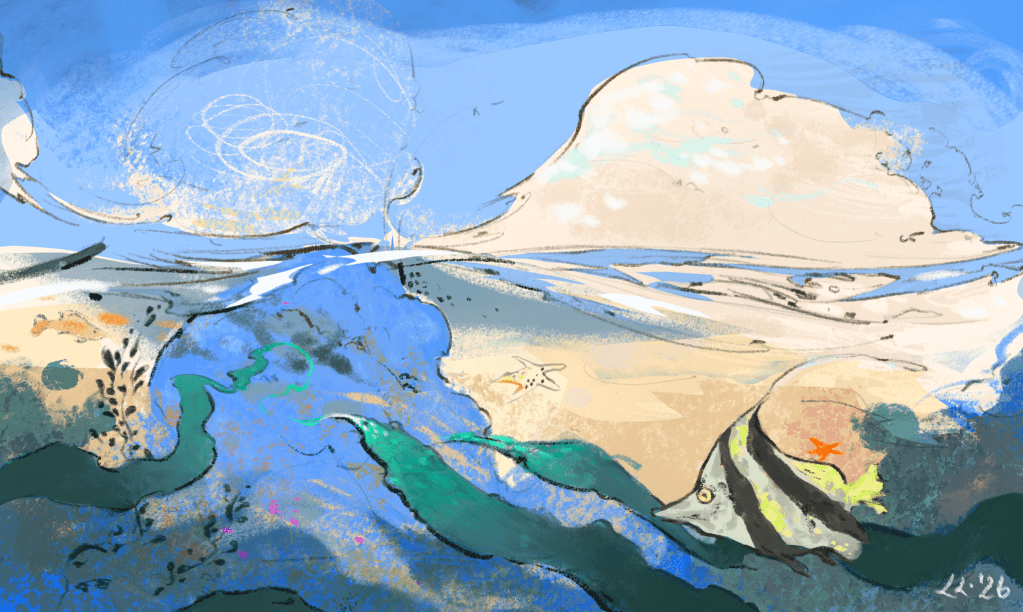
The fish are everywhere and nowhere at once, and a coolness that’s more than physical spreads from my scalp to my teal nylon shoulders, and over my arms, which suddenly feel like fins. Some glisten around us in currents, in schools of seemingly millions, or just small groups. There are families of the most spectacular colorations, variations in size also changing the markings of their scales. I’ve never before thought about juvenile fish. Babies of electric purple that stretch into gangly teens, that fatten into the solid adults shepharding at the edges of the group. They are translucent, opalescent, but precisely muscular slabs. There are loners adrift, too – one silver body with cheeks blushing yellow and streaked with dusty rose, one thin and iridescent, with pursed lips of at least a third of that length. I see parrot-colored flesh, and black dapples as perfect as parquet. One dark gray-blue fish hovers near a wide, flat bloom of coral and flexes his tail at the sky, lunging down to take crunching bites. The sound is crisp and feels very near, although the sandy bottom is peeling itself farther and farther away from where we float at the surface, as we work our way out from the shore. The light here is dull, and the moving patterns of the sun intricate webs on the rocks far below. Brown-spotted starfish, which were scattered plentifully across the sand behind us, are curled into crevices here. Corals are densely ringed by seaweed, which waves and parts to reveal the occasional mercurial tail or flash of bright-colored fin. The tremendous spikes of sea urchins rise out of other gaps, and when I am directly overhead of one, I feel another chill – its base appears studded with glowing neon eyes and a small central mouth.
Meters before me, Matteo gestures for me to reach him, and as I propel myself forward, he points downward. Over the edge of a sudden slope, the distance is only shadow, apart from one filmy white presence. A small jellyfish is suspended at the edge of darkness, working its mushroom-like body in a dance of frilly gestures. I am overtaken by some kind of fear – not of its stinging potential, but of its strangely humble presence in the absence of sunlight beyond.
A torrent of silver cuttlefish rushes by our our treading appendages, their stubby tentacles working brightly as they flee into the looming void. We stay, suspended, rubber tubes puncturing the only layer of blue we can breathe.
 persimmoness