the layer between blues

Culion Islands, Philippines

For three days the sun sits on us. In this wide place of sparkling waves, wet nylon flags flutter above me, sleeves tied around pillars, and I feel like the heat is pressing me powerless into the crevices of painted wood rocking underneath, the shadow of the narrow roof moving relief briefly over my body and away again. When we’re on the beach, the light comes from everywhere, and cupping my hands over my eyes is not enough, because the ground is white sand and brilliant coral and it presses up up up while the sun presses down and all I can do is squint to see the blue that I’ll marvel at in pictures later.

But in the water, everything is different. It was hard to breathe through the tube at first – one heavy inhale to inflate the soft belly of its curve, another to inflate my lungs. I turn my head too far, sputtering in saltwater, and thrash upwards, freeing myself of rubber bits. Matteo tells me instead to keep my head under and spout like a whale. Then, I practice a tense grip with my teeth on the denture-like seal, and the breath becomes fluid in a sky of water. It doesn’t look blue, but it feels blue.

I slowly trust myself to float face-down. When I do, I see the blue too, but it’s not the water itself. It’s indigo banks of coral that mimic the sky, with white expanses of sand in between. Interspersed in this tranquil landscape are craggy towers of yellow-brown, studded with what look like tiny neon plastic Christmas trees, cones of feathered layers stacked on a central stalk. Matteo lunges under in a shallow arc and wiggles his fingers at them. The colors vanish in an instant, fibrous tongues retracted into little mouths in the coral wall.
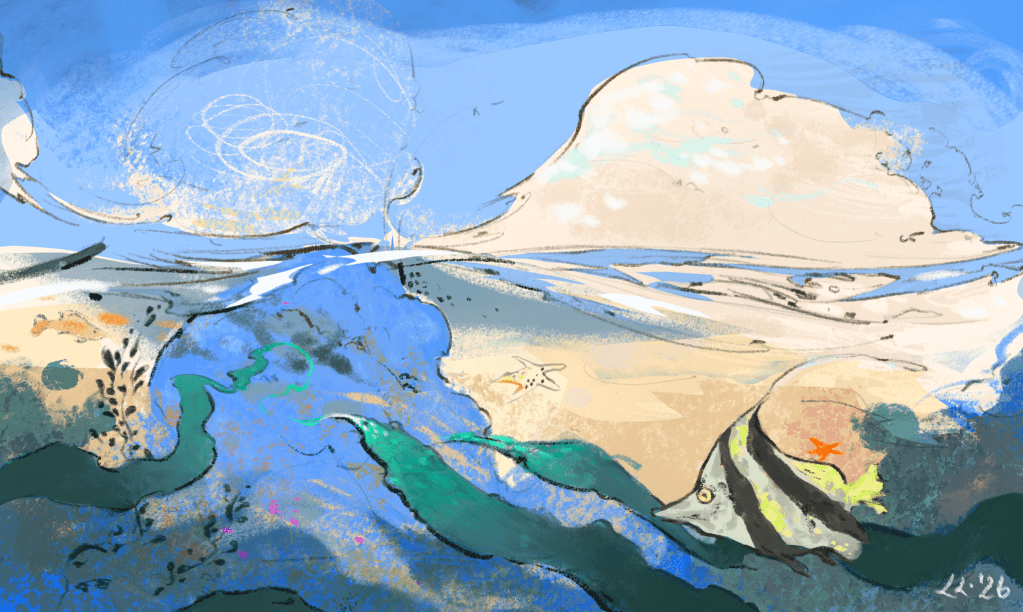
The fish are everywhere and nowhere at once, and a coolness that’s more than physical spreads from my scalp to my teal nylon shoulders, and over my arms, which suddenly feel like fins. Some glisten around us in currents, in schools of seemingly millions, or just small groups. There are families of the most spectacular colorations, variations in size also changing the markings of their scales. I’ve never before thought about juvenile fish. Babies of electric purple that stretch into gangly teens, that fatten into the solid adults shepharding at the edges of the group. They are translucent, opalescent, but precisely muscular slabs. There are loners adrift, too – one silver body with cheeks blushing yellow and streaked with dusty rose, one thin and iridescent, with pursed lips of at least a third of that length. I see parrot-colored flesh, and black dapples as perfect as parquet. One dark gray-blue fish hovers near a wide, flat bloom of coral and flexes his tail at the sky, lunging down to take crunching bites. The sound is crisp and feels very near, although the sandy bottom is peeling itself farther and farther away from where we float at the surface, as we work our way out from the shore. The light here is dull, and the moving patterns of the sun intricate webs on the rocks far below. Brown-spotted starfish, which were scattered plentifully across the sand behind us, are curled into crevices here. Corals are densely ringed by seaweed, which waves and parts to reveal the occasional mercurial tail or flash of bright-colored fin. The tremendous spikes of sea urchins rise out of other gaps, and when I am directly overhead of one, I feel another chill – its base appears studded with glowing neon eyes and a small central mouth.

Meters before me, Matteo gestures for me to reach him, and as I propel myself forward, he points downward. Over the edge of a sudden slope, the distance is only shadow, apart from one filmy white presence. A small jellyfish is suspended at the edge of darkness, working its mushroom-like body in a dance of frilly gestures. I am overtaken by some kind of fear – not of its stinging potential, but of its strangely humble presence in the absence of sunlight beyond.

A torrent of silver cuttlefish rushes by our our treading appendages, their stubby tentacles working brightly as they flee into the looming void. We stay, suspended, rubber tubes puncturing the only layer of blue we can breathe.
the amaryllises

It’s New Year’s Eve and I’m in Sorrento, sitting in a bar at the edge of a big group, and I’m drawing. I’m drawing like some people smoke – moving my hands to match the movements of my thoughts and my nods. I’m not talking much, because my Italian is tired, and even my English, and it’s easier to outline shadows with my pencil than sentences with my mouth. I want to listen to the space as well as the conversation, to see the way the walls are jointed and the light falls and the objects move and capture on my page not the way that it looks but the way that it feels.

This is what I’ve realized about drawing, and about writing, and any way I might combine them, after years of searching for my creative path – it’s not about what things look like exactly, it’s about the way they feel to me. Although this perspective might have felt self-centered to me a decade ago, when I was wading through a conceptual art degree, resisting with all my might a world where it seemed like success required selling self-involvedness, I’ve now seen a different facet. There is no one reality to be expressed – there are thousands. I try like Thoreau to be transparent, but my eye will always be filtered through my style. I wish I’d known years ago that style is just what happens when you just keep creating in every situation and as every version of yourself, reach your superficial goals so that you stop feeling like you need to prove anything, and see what remains consistent.

Someone once told me a superstition: that the way you spend your New Year’s Eve will predict your coming year. In Sorrento, as I always do, I’m thinking about this, and wondering, will this year be the year that things happen? That I create stronger creative habits and vanquish my fear of sharing, that I publish something? That I start introducing myself first as an illustrator before admitting I’m a part-time barista? This year, I’ve been exploring, seeing, speaking, thinking, and in this moment my hands are doing what I want to do with that. I just need to keep letting them do it.

It’s February of this next year, and I’m in the house where I grew up. Half of the amaryllises are blooming over the wood stove, which had been used once in the snow storm last week. Probably the heat triggered the blossoms, but it could also be this week’s sudden sun and sixteen degrees of warmth pouring through the skylights. Jet lag has me awake early enough to see gold just at the tops of the pines outside, before it begins to chase blue shadows down the trunks.

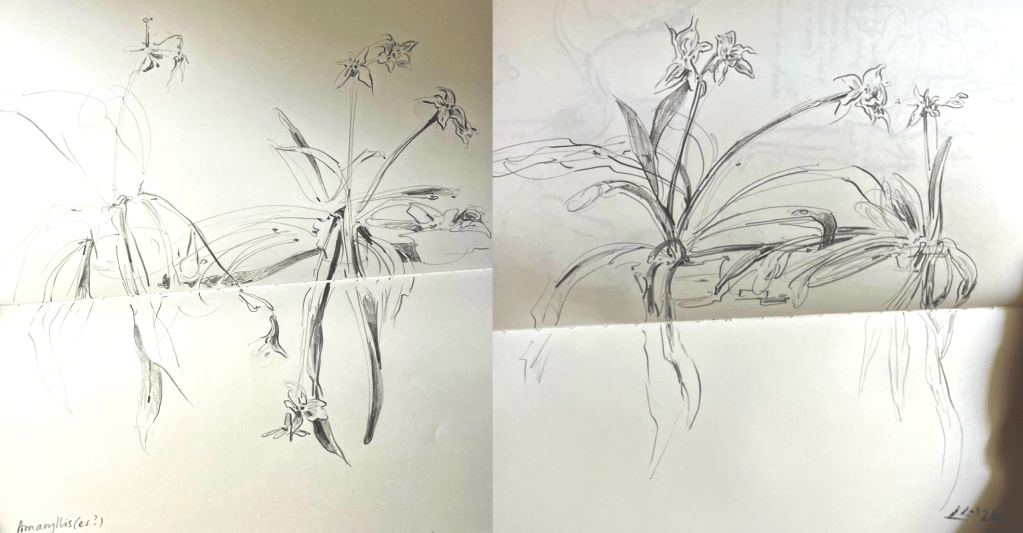
The amaryllises only bloom once a year, and I only visit once a year. I’ve been thinking all week about drawing them. I trace their grand stems with my eyes, the red petals like curled fingers at the edge of a dance, the pleated arcs of the leaves heavy like cast wax. As is often the case when I see something beautiful and have time to sketch it, I do not touch my pencil. But here, I have also been haunted by the old old pictures of mine hanging here, for which I was told I had promise, which I took as a promise. I have been thinking of other things.

Home is just the first step of a very long trip. I quit my barista job, and now I can only introduce myself as an illustrator. I have a backpack, a thin book in which I write, and one in which I draw. Probably I will do both in both. I have a flight booked that will take me another third of the way around the world, to a place where no old pictures of mine hang.

Eventually, I see that the tips of the grand amaryllis blossoms are beginning to darken, and then they begin to shrivel into ringlets. One grand stem leans. I decide to draw it before it starts to droop. And later, the golden square of skylight highlights the blossoms on the other side, and as one plant wilts another blooms, and I have to draw it too.

armature

In the past month, I’ve lost four out of four items of jewelery in my daily-wear rotation. The first, a simple silver chain with a tiny quartz pendant, with an understated-but-slightly-hippie worn silver setting, was a loss due to unthinking error. Before pole class, I carefully put the necklace together with the hammered silver earrings I have been wearing almost every single day into a small zippered pocket of my favorite leather jacket. Because the jacket was hanging, I did not zip the pocket. Floating on a high from the climbing and flipping and pleasant exhaustion, I stepped from the studio into the first rays of Berlin spring sunshine and allowed myself to photosynthesize. And unfolded the leather leaves around my shoulders, and then freed the sallow stems of my arms. And then my jacket, unzippered, chains and earrings unfettered, hung upside-down for fifteen minutes by foot and another fifteen by bus.

The second was my second-favorite pair of large silver hoops. These were of flexible wire, bent in several places, which had never fastened well – yet had survived many years of regular wear. Like the other silver hoops and the necklace, they had belonged to an aunt who died before I was born, whose jewelery was lovingly meted out to me through my pre- and teenage years by my grandmother. These hoops I sometimes used to suspend another silver pendant from a dismantled set of earrings from the same grandmother, whose long-lost ability to retain both ear adornments through even a single day I currently relate to. That ear-adornment combination was my most highly complimented. It will never be again.

The third was one of a set of delicate pendant earrings of time-blackened silver, each made up of two thin and sculptured concentric circles, with a tiny freshwater pearl dangling off the bottom. These were re-gifted to me by my mother because they never really suited her style. For me they certainly did, though they were special-event earrings until I lost my standard ones.

All of these items, together, were my most used and cherished sets of armor. I needed these pieces. I had read somewhere that quartz was thought to be protective, and I was calmed by smoothing the pendants subtle faces and sliding it back and forth on its chain. I needed these things to keep me rooted to one facet of my identity, when I’m a continent away from the people who gave these pieces to me. I needed these things to give me a Berlin cool-girl coolness – as much as I hate to admit to that sliver of doubt that also motivated my self-ornamentation – to give me weight on the city streets which have often overwhelmed and intimidated me.

In my mind, I’ve been calling this armature, which just sounds to me like an old-fashioned way to say the same thing. But I just looked up the word, and Oxford says:

noun: armature; plural noun: armatures

  1. 1.the rotating coil or coils of a dynamo or electric motor.
    • any moving part of an electrical machine in which a voltage is induced by a magnetic field.
    • a piece of iron or other object acting as a keeper for a magnet.
  2. 2.an open framework on which a sculpture is moulded with clay or similar material.
    • a framework or formal structure, especially of a literary work.”Shakespeare’s plots have served as the armature for many novels”
  3. 3.BIOLOGYthe protective covering of an animal or plant.
    • ARCHAIC armour.

Little did I know, my armature was archaic. I would less like to be a soldier than a being firmly in the biological category, with a naturally-grown covering. I would not like to hide behind plated silver. In the late hours of the evening after discovering all of these losses, I had feared and suspected the universe was giving me some sort of message, preparing me for another sort of loss. But maybe, I am being prepared for another sort of transition. Maybe, I am now to prepare myself for an active shift. If I need armature, it’s maybe as a keeper for a magnet – but to attract what? It’s maybe the framework of my narrative, which I am now charged with constructing. My protective covering has been pulled away, and I am being asked to reconsider what my armature was even there for.